Home
Classes
Bonobo Research
Development Research
Fiction
Links
Christine M. Johnson PhD

Department of Cognitive Science
University of California San Diego
La Jolla, CA 92093-0515

johnson@cogsci.ucsd.edu

CURRENT CLASSES:

CS17  Cognitive Neuroscience

CS101A  Human Perception

CS184  Modeling Cognitive Evolution

CS143  Animal Cognition

CS199  Independent Studies:
Comparative Social Cognition

ISSUES OF INTEREST:

CURRENT RESEARCH:
Bonobo Social Attention
Bonobo Gesture Development
Invisible Displacement in Dolphins
Dolphin Social Attribution
Elephants' Social Construction of Space
Ontogeny of Human Triadic Attention
My primary interest is in the evolution of social cognition and in taking a comparative approach to its study. In our lab, we do observational analyses of real-world interactions between socially sophisticated animals, including bonobos, dolphins, elephants and humans. These multi-scalar analyses include frame-by-frame video the micro-, macro- and historic levels. By applying a model of "Distributed Cognition"* to such interactions, we aim to understand the media of information flow, and the constraints on their co-regulation, in these dynamic systems.

SELECTED REFERENCES:

Johnson, C. M. (2010) Observing cognitive complexity in primates and cetaceans. International Journal of Comparative Psychology, 23, 587-624.

Hutchins, E. & Johnson, C. M. (2009) Modeling the emergence of language as an embodied collective cognitive activity. Topics in Cognitive Science, 1, 523-546.

Johnson, C. M. & Karin-D'Arcy, M.R. (2006) Social attention in nonhuman primates: A behavioral review. Aquatic Mammals, 32, No 4:423-442.

Johnson, C. M. & Herzing, D. L. (2006) Primate, cetacean & pinniped cognition compared: An introduction. Aquatic Mammals, 32, No 4:409-412.

Johnson, C.M. (2004). The micro-ethology of social attention: "Brightness" in bonobos. Folia Primatologica: 75(suppl 1), 175.

Johnson, C.M. (2002). The Vygotskian advantage in cognitive modeling: Participation precedes and thus prefigures understanding. Behavioral and Brain Sciences 25: 628-629.

Johnson, C. M. (2001) Distributed primate cognition: A review. Animal Cognition 3, No 4:167-183

Johnson, C.M. & Keil F.C. (2000) Explanatory knowledge and conceptual combinations. In F.C. Keil & R.A. Wilson (Eds) Explanation and Cognition, pp: 327-360, MIT Press, Cambridge.

Johnson, C. M., Frank, R. E. & Flynn, D. (1999) Peering in mature, captive bonobos (Pan paniscus). Primates, 40.2: 397-407.

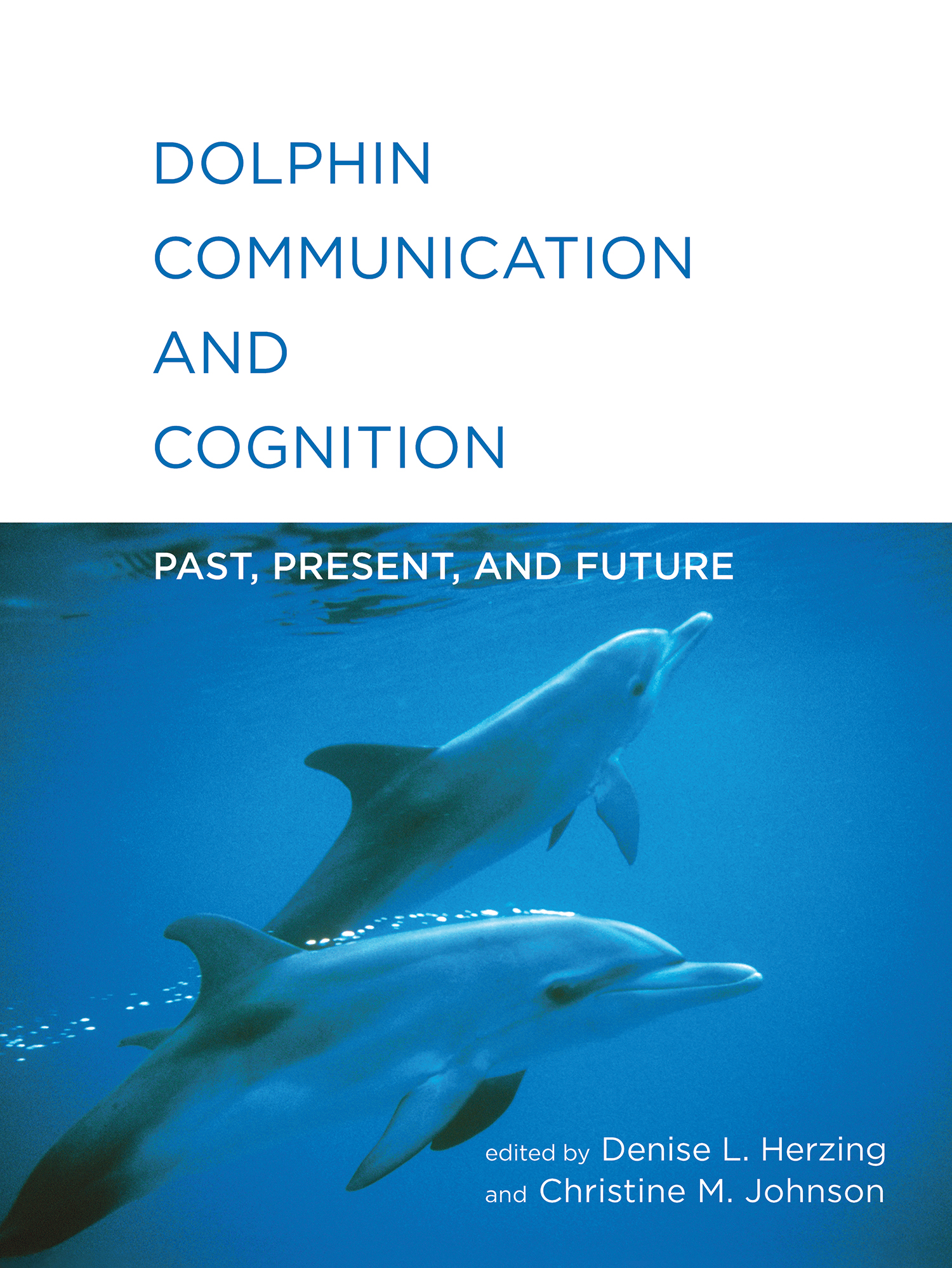
Johnson, C.M. & Moewe, K. (1999) Pectoral fin preference during contact in Commerson's dolphins (Cephalorhynchus commersonii). Aquatic Mammals, 25.2: 73-77.

Herzing, D. L. & Johnson, C. M. (1997) Interspecies interactions between Atlantic spotted dolphins (Stenella frontalis) and bottlenose dolphins (Tursiops truncatus) in the Bahamas, 1985-1995. Aquatic Mammals, 23: 85-99.

Johnson, C.M. (1994). Whales and dolphins: Acoustic signals. In R.E. Asher (Ed.) The Encyclopedia of Language and Linguistics, Vol. 9: pp 4972-80. Oxford: Pergamon Press.

Bauer, G.B. & Johnson, C.M. (1994). Trained motor imitation by bottlenose dolphins (Tursiops truncatus). Perceptual and Motor Skills, 79: 1307-1315.

Johnson, C.M. & Norris, K.S. (1994). Social behavior. In K.S. Norris, B. Wursig, R.S. Wells & M. Wursig (Eds.) The Hawaiian Spinner Dolphin. Berkeley, CA: University of California Press, pp. 243-286

Johnson, C.M. (1993). Animal communication via coordinated cognitive systems. In P.P.G. Bateson, N. Thompson & P. Klopfer (Eds.) Perspectives in Ethology, Volume X: Variability in Behavior, pp. 187-207. NY: Plenum.

Johnson, C.M. (1990). Evolutionary, comparative, and psycholinguistic investigations on the nature of higher-order cognitive processes. Ph.D. Thesis. Cornell University, Ithaca, NY.

*With thanks... Hutchins E (1995) Cognition in the wild. MIT Press, Cambridge MA

Site last updated: August 2011